Now Reading: Why Is Gaming So Expensive Now? 10 Cheap Video Games and Hidden Gems Worth Playing Instead
-
01
Why Is Gaming So Expensive Now? 10 Cheap Video Games and Hidden Gems Worth Playing Instead
Why Is Gaming So Expensive Now? 10 Cheap Video Games and Hidden Gems Worth Playing Instead
Cheap video games and hidden gems don’t get front page treatment. That’s kind of the point.
Keeping up with modern gaming feels less like a hobby and more like a second mortgage. We arrived at the seventy-dollar base game era, and the industry immediately decided that wasn’t enough. Factor in battle passes, “digital deluxe” upgrades that just let you play four days early, and story DLC that patches up a broken narrative, and you’re looking at a triple-digit investment for a single title. Half the time you fork over that cash, you end up serving as an unpaid beta tester for a launch-day mess that needs another six months in the oven to run at a stable frame rate.
The big publishers want you to believe the only way to have a great experience is to chase the latest marketing hype cycle. They’re wrong.
Look past the front page of any digital storefront, away from the pre-order banners and seasonal events, and there’s a massive graveyard of absolute masterpieces. Games with massive budgets, brilliant design teams, and glowing reviews that flopped commercially because of terrible release windows, nonexistent marketing, or corporate politics.
Today, those failures are your gain. Because they didn’t sell billions of copies at launch, they constantly go on sale for pennies on the dollar.
The Best Cheap Video Games and Hidden Gems You’ve Never Played
Here are 10 incredible gaming hidden gems you can get for cheap right now.
1. Sleeping Dogs: Definitive Edition
When Activision looked at Sleeping Dogs during development, they panicked, decided it couldn’t compete with Grand Theft Auto, and canceled it outright. Square Enix rescued it from the trash bin, published it, and gave us one of the greatest open-world action games ever made. Because it never hit astronomical sales targets, it never got the franchise treatment it deserved.
Rather than cloning the Rockstar formula, Sleeping Dogs focuses heavily on brutal, Arkham-style hand-to-hand martial arts. You play as Wei Shen, an undercover cop infiltrating the Sun On Yee Triad in Hong Kong. The narrative is a tense crime drama that feels like stepping directly into a classic John Woo film.
What makes the gameplay loop legendary is how it integrates the environment into combat. You can grapple an enemy, drag them across a market, and slam them into a meat hook or a phone booth. The driving is loud and arcadey. You can leap from a moving motorcycle onto the roof of a suspect’s car mid-chase. The Definitive Edition bundles in every piece of DLC and regularly goes on sale for less than five dollars. It runs flawlessly on modern hardware, and the neon-lit, rain-soaked streets of Hong Kong still hold up.
2. Singularity
Released in 2010 by Raven Software, right before Activision locked them in the Call of Duty support dungeon forever, Singularity is a sci-fi first-person shooter that feels like a love letter to BioShock and Half-Life 2 written in the margins of a Timesplitters manual.
You play as an American black ops soldier sent to investigate an abandoned Soviet research facility on a mysterious island called Katorga-12. The Soviets found an element called E99 that let them manipulate time before a massive catastrophe buried the whole project.
The star of the show is the Time Manipulation Device strapped to your wrist. You can age objects forward into rust and dust or reverse them back to their pristine states. In combat, you can target an enemy soldier and instantly age him into a skeleton, or revert a mutated monster back into a harmless state. Environmental puzzles have you repairing collapsed bridges, decaying massive crates to fit through doorways, then restoring their size to use as platforms. It’s a fast-paced, highly inventive linear shooter that costs next to nothing during Steam sales. A genuine hidden gem that flew completely under the radar.
3. System Shock 2
Before BioShock told us “Would you kindly,” and long before Prey put us on a haunted space station, there was System Shock 2. Released in 1999 and co-developed by Looking Glass Studios and Irrational Games, this is the definitive DNA donor for the entire immersive sim genre.
You wake from cryo-sleep aboard the Von Braun, a state-of-the-art starship where the crew has been mutated into a horrific hive-mind collective called The Many. They’re not even your biggest problem. The ship’s rogue AI, SHODAN, is back. Her cold, dripping contempt for the “elements of flesh” remains one of the most chilling performances in gaming history.
System Shock 2 blends terrifying survival horror with deep RPG mechanics. Specialize in technical hacking, heavy weaponry, or psionic alien powers. The game doesn’t hold your hand. Every resource is scarce, every weapon degrades, and the atmosphere is heavy with genuine dread. The Nightdive Studios Enhanced Edition runs perfectly on modern rigs and goes on sale for peanuts regularly. If you want to see where modern sci-fi horror got its teeth, start here.
4. Prince of Persia: The Lost Crown
Ubisoft spent years building a reputation for bloated, repetitive open-world games that feel more like checklists than art. So when they announced a 2D side-scrolling Metroidvania in the dormant Prince of Persia franchise, most gamers assumed it was a cheap cash-in.
It wasn’t. The Lost Crown is a masterclass in game design, with some of the tightest platforming and deepest combat systems the genre has seen since Hollow Knight.
You play as Sargon, a young warrior sent to a cursed, time-twisted citadel to rescue the kidnapped prince. The movement feels incredibly fluid, giving you air dashes, slides, and teleportation powers that turn navigation into an intricate dance. Combat demands parries, combo extensions, and positional awareness. Ubisoft also introduced a genius quality-of-life feature called Memory Shards, which lets you take a screenshot of a blocked path and pin it directly to your map so you always remember why you couldn’t progress. It underperformed commercially, dropped in price fast, and is now one of the best cheap video games available for anyone who appreciates tight, challenging gameplay.
5. Marvel’s Guardians of the Galaxy
When Square Enix’s live-service Avengers game disappointed everyone, the gaming community assumed Guardians of the Galaxy would be more of the same corporate, microtransaction-stuffed nonsense. Millions of people skipped it entirely.
They missed out on one of the finest linear, narrative-driven action adventures of the last decade. This is a fully single-player game with zero microtransactions and zero live-service bloat. The story handles the emotional core of these characters better than the MCU films do.
You play exclusively as Peter Quill, directing your team of misfits in battle while juggling their chaotic personalities. The writing is incredibly snappy. The banter between Rocket, Groot, Gamora, and Drax never stops, and it adapts dynamically to how you explore environments and perform in combat. The soundtrack is a massive love letter to 1980s rock and pop, pulling from Iron Maiden to Rick Astley. When you trigger your team Huddle mechanic mid-battle, the music kicks in and transforms chaotic sci-fi brawls into pure joy. It’s a premium production that frequently dips below fifteen dollars.
6. Alan Wake 2
It might seem strange to call Alan Wake 2 a cheap hidden gem, given it won multiple Game of the Year awards. But its unique distribution model, launching as a digital-only Epic Games Store exclusive on PC with rapid console price drops, means this modern psychological horror masterpiece can be had for a serious steal compared to standard launch prices.
Remedy Entertainment spent 13 years trying to get this sequel made. They didn’t hold anything back. The narrative splits between Saga Anderson, an FBI profiler investigating ritualistic murders in the Pacific Northwest, and Alan Wake, a trapped writer trying to script his escape from a nightmare version of New York City called the Dark Place.
One moment you’re surviving tense, resource-management brawls in a dark forest. The next you’re navigating a fully choreographed rock opera that shifts the reality of the level around you. It’s one of the most visually stunning, narratively daring games ever produced. Frequent digital sales and coupon events mean you don’t need to drop seventy bucks to experience it.
7. The Last Guardian
Few games have survived development hell like The Last Guardian. Directed by Fumito Ueda, the visionary behind Ico and Shadow of the Colossus, the game spent nearly a decade in corporate limbo before finally launching on PlayStation 4 in 2016. The hype machine had moved on by then, and it quietly became a forgotten hidden gem buried in bargain bins.
The game follows a young boy who forms an unlikely bond with Trico, a massive feathered creature that’s something like a bird, a cat, and a griffin rolled into one. What separates this from a standard companion game is Trico’s artificial intelligence. He doesn’t behave like a predictable video game asset. He acts like a real, stubborn, living animal.
At first he might ignore your calls, hesitate at obstacles, or throw a tantrum when frightened. As you feed him, clear spears from his flanks, and guide him through the crumbling ruins of a mysterious valley, the trust between you grows. The emotional payoff at the end is unmatched. You can pick it up on the PlayStation Store right now for a fraction of its original cost.
8. Mad Max (2015)
The 2015 Mad Max game is the textbook definition of a victim of a terrible release window. Warner Bros. launched it on the exact same day Metal Gear Solid V: The Phantom Pain hit shelves. Predictably, the press and public completely ignored it to cover Hideo Kojima’s departure from Konami.
That’s a genuine tragedy. Developed by Avalanche Studios, the team behind the Just Cause series, Mad Max captures the desperate, metallic crunch of the post-apocalyptic wasteland better than almost any other piece of media in the franchise.
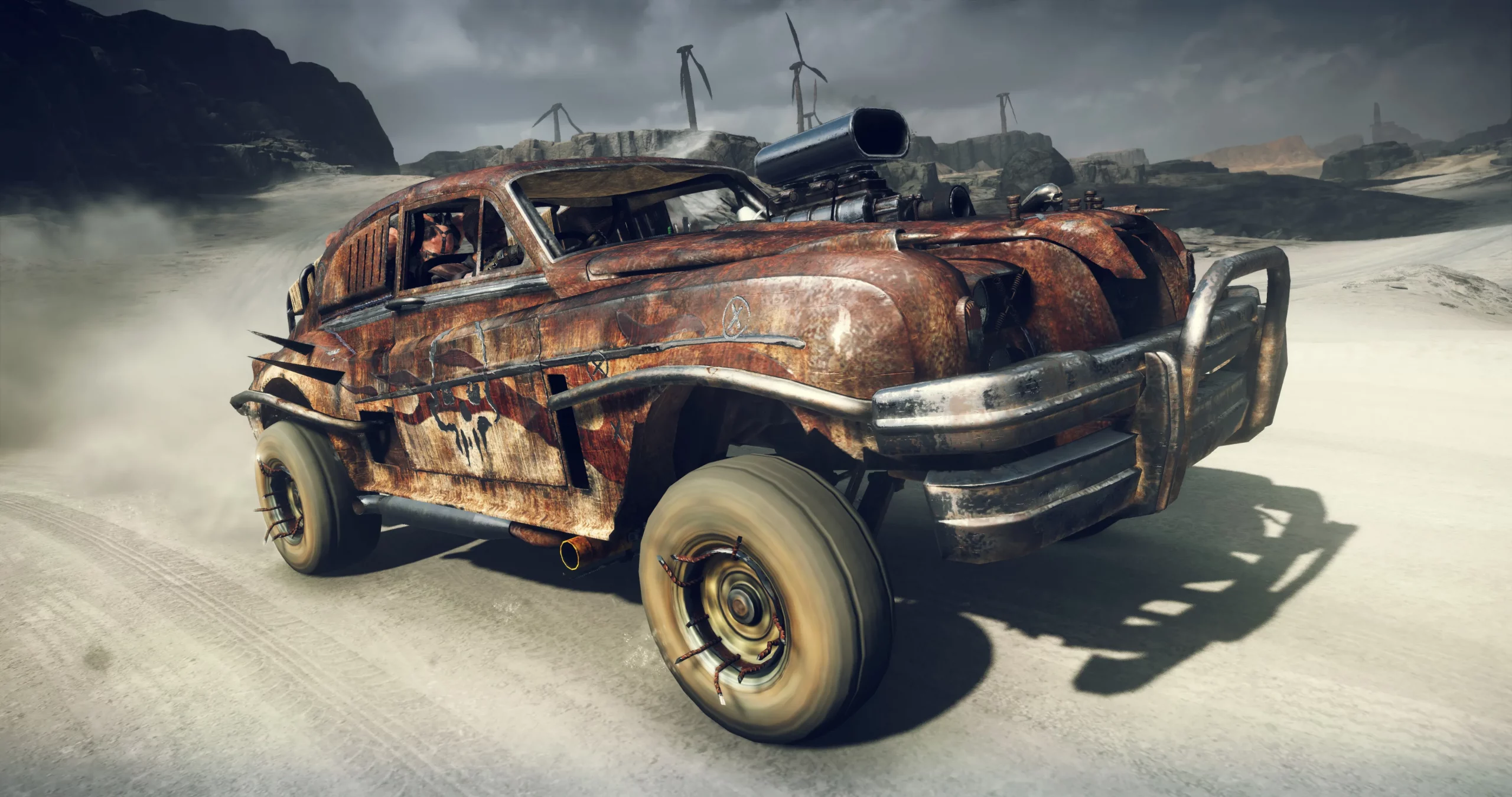
Your time is split between brutal ground combat and high-speed vehicular warfare. Upgrading your car, the Magnum Opus, is the core loop. You start with a rusted, sputtering frame and build it into an armor-plated, nitro-fueled death machine loaded with harpoons, sniper rifles, and flamethrowers. Ripping the door off an enemy vehicle with a harpoon, pulling the driver into the sand, and boosting away as their convoy explodes behind you never gets old. It regularly goes on sale for under five bucks and offers fifty hours of premium open-world content for the price of a fancy coffee. One of the most slept-on cheap video games ever released.
9. Dishonored 2
Arkane Studios makes the list because the world simply refuses to buy immersive sims at launch. Dishonored 2 improves on the incredible foundation of the original in every meaningful way, yet a rough PC launch and terrible marketing caused it to sell poorly against generic military shooters.
Set years after the original, you can play as either Corvo Attano or his daughter, the deposed Empress Emily Kaldwin. Each character has an entirely distinct set of supernatural abilities. Corvo blinks across rooftops and possesses rats. Emily summons a shadow clone to distract guards or links the fates of multiple enemies together so that putting one to sleep knocks them all out simultaneously.
The level design is legendary. The Clockwork Mansion is a mechanical house where pulling levers physically shifts the walls, floors, and ceilings to reveal hidden pathways. Another level hands you a device that lets you switch between two time periods in real time to navigate obstacles. It’s a deep sandbox that rewards creativity, and you can grab it along with its standalone expansion for less than ten dollars during almost any major sale.
10. Beyond Good & Evil
Let’s go back to an old-school classic everyone should experience. Released by Ubisoft in 2003 and designed by Michel Ancel, the creator of Rayman, Beyond Good & Evil was planned as the first part of a trilogy. It launched into a crowded holiday season alongside Prince of Persia: The Sands of Time and sank without a trace. One of the original cheap video game hidden gems, and still one of the best.
You play as Jade, a photojournalist and martial artist living on a mining planet under siege by an alien threat called the DomZ. Suspecting the military dictatorship running the planet is secretly colluding with the aliens, Jade joins an underground resistance to expose the truth.
Your primary weapon is your camera. You sneak into secure military facilities, photograph evidence of corporate conspiracies, and transmit the pictures to the public to ignite a revolution. The game blends stealth, martial arts combat, hovercraft racing, and exploration into one cohesive, charming package. A recent remastered version brings it up to modern display standards. No better time to pick up this foundational piece of gaming history for cheap.
Honorable Mention: Enslaved: Odyssey to the West
Before Ninja Theory blew everyone away with Hellblade: Senua’s Sacrifice, they teamed up with screenwriter Alex Garland and performance-capture legend Andy Serkis to deliver this absolute gem in 2010. A sci-fi, post-apocalyptic reimagining of the classic Chinese novel Journey to the West, Enslaved was critically adored and completely buried by Namco Bandai’s nonexistent marketing.
Instead of the standard gray-and-brown wasteland, Enslaved hands you a world where nature has fully reclaimed the concrete. You play as Monkey, a muscle-bound loner forced to escort a tech-savvy woman named Trip across a vibrant, green, machine-infested ruin of New York City. The hook: you’re wearing a slave headband linked to her vitals. If her heart stops, your head explodes.
The puzzle-platforming and staff-swinging combat are satisfying, but the genuine, evolving dynamic between Monkey and Trip is what anchors the whole package. The Premium Edition routinely drops to less than three bucks during Steam sales. If you want a masterclass in linear, narrative-driven action that doesn’t overstay its welcome, don’t sleep on this one.
TL;DR (For The Skippers)
Looking for cheap video games and hidden gems without reading the full breakdown? Here’s the fast track to saving your wallet from seventy-dollar disappointment.
Sleeping Dogs: Definitive Edition // Open-world Hong Kong crime drama with the best martial arts combat in the genre. Under five bucks on sale, regularly.
Singularity // Sci-fi shooter with time-manipulation mechanics that punches way above its price tag. Costs next to nothing on Steam.
System Shock 2 // The literal DNA donor for Prey and Dead Space. Incredible atmosphere, terrifying rogue AI, dirt cheap.
Prince of Persia: The Lost Crown // Some of the tightest platforming and deepest combat systems of the decade. Dropped in price fast because Ubisoft didn’t market it.
Marvel’s Guardians of the Galaxy // Zero live-service bloat, fantastic character banter, and a killer 1980s rock soundtrack. Frequently under fifteen dollars.
Alan Wake 2 // A masterpiece of atmospheric tension and multimedia storytelling. Digital-only distribution means heavy sale discounts hit constantly.
The Last Guardian // A beautiful, emotional puzzle-adventure built around a remarkably lifelike animal AI companion. Fraction of launch cost now.
Mad Max (2015) // Vehicular wasteland warfare done right. Got buried by launching the same day as Metal Gear Solid V, making it a classic five-dollar bargain bin legend.
Dishonored 2 // Architectural masterclasses in level design and total freedom in how you tackle objectives. Usually under ten bucks.
Beyond Good & Evil // Foundational gaming history that blends stealth, combat, and exploration into one charming package. The remaster is cheap and runs flawlessly.
Honorable Mention: Enslaved: Odyssey to the West // Written by Alex Garland, starring Andy Serkis. A fantastic linear journey with great character dynamics that costs less than a coffee on sale.

AJ Hanson has been part of games media since 2011, writing, streaming, and ranting about the industry long before it was his job. He runs the Galaxy’s Edge Discord, the go-to community for fans of Disney’s Star Wars parks, and works as Marketing Director for the Virtual Cantina Network, helping produce shows, interviews, and fan events. A lifelong Star Wars fan and unapologetic nerd, AJ’s focus has always been on building spaces where people can connect, argue, and celebrate the things they love without all the corporate gloss.